
It is one of the questions parents asked me at the end of the school year, when report cards are handed out.
Many of you share the same concern:
“My child understands French but does not speak it.”
You are anxious. You wonder if something is wrong, if your child is falling behind or if you should intervene more.
First of all, it is important to remember one thing: every child is different, and every family language situation is unique.
Two different family situations :
1- French-speaking parent
In some families, one parent is French and the other speaks another language (Chinese, English, etc.).
The child understands French very well, but answers in the other language.
Why ?
Because the child knows the French-speaking parent understands that language too.
It feels easier. It requires less effort.
A few years ago, a French father told me that his daughter C. understood everything he said but refused to answer him in French. Since the father understood Chinese, she answered him in…Chinese ! This lasted throughout the entire school year. The following year, this little girl was communicating perfectly in French !
2- Non-French-speaking parents
In other families, both parents are non-French speakers.
French is not used at home, so the child does not need to speak it outside school.
The child hears and uses French only at school. At home, there are simply fewer opportunities to practice speaking.
French is therefore a language of learning for your child and not a language of communication.
This situation is very common among bilingual children.
Why a bilingual child understands French but does not speak it ?
Children naturally choose the easiest option
Children instinctively choose the language they master best. They communicate in a language only if they need to.
In my own classes, my students never speak Chinese to me, simply because they know I don’t understand it.
If they want to communicate, they have to use French.
The need creates the language.
Each child develops at their own pace
Just as every family has a different linguistic balance, every child develops differently.
Some children start speaking French quickly, even if they mix languages (code-switching).
Others wait until they feel confident enough to produce a correct sentence before speaking at all. It was the case with C. She waited a year before speaking out. Sometimes it takes months, weeks. There are no rules.
Both paths are normal.
If a child understands French but does not speak it yet, it often means one thing: they are not ready … yet.
They need time to build confidence and internalize the language.

For many bilingual children, understanding French without speaking it yet is a natural stage of language development.
What worries parents… often unnecessarily
1- I don’t see any progress
This concern is completely understandable. When a child is silent, progress feels invisible.
But progress is happening. Quietly.
One day, it suddenly appears and sometimes in a simple sentence like:
“ Est-ce que je peux aller aux toilettes maîtresse ? ”
And that moment is often the result of months of silent preparation. Sometimes the children who take the longest to speak are the most talkative when they start !
2- Other children speak, but mine doesn’t
Comparison is very common and very unfair to children.
Many factors influence language development:
- the family’s linguistic environment
- the child’s personality (shy, outgoing…)
- the number of years of exposure to French
- the child’s age when learning French
- language stimulation at home
- the family’s attitude toward French
In 25 years of teaching, I have seen every possible situation.
There is no race.
There is no “last child”.
Everyone can become bilingual or plurilingual at their own pace.
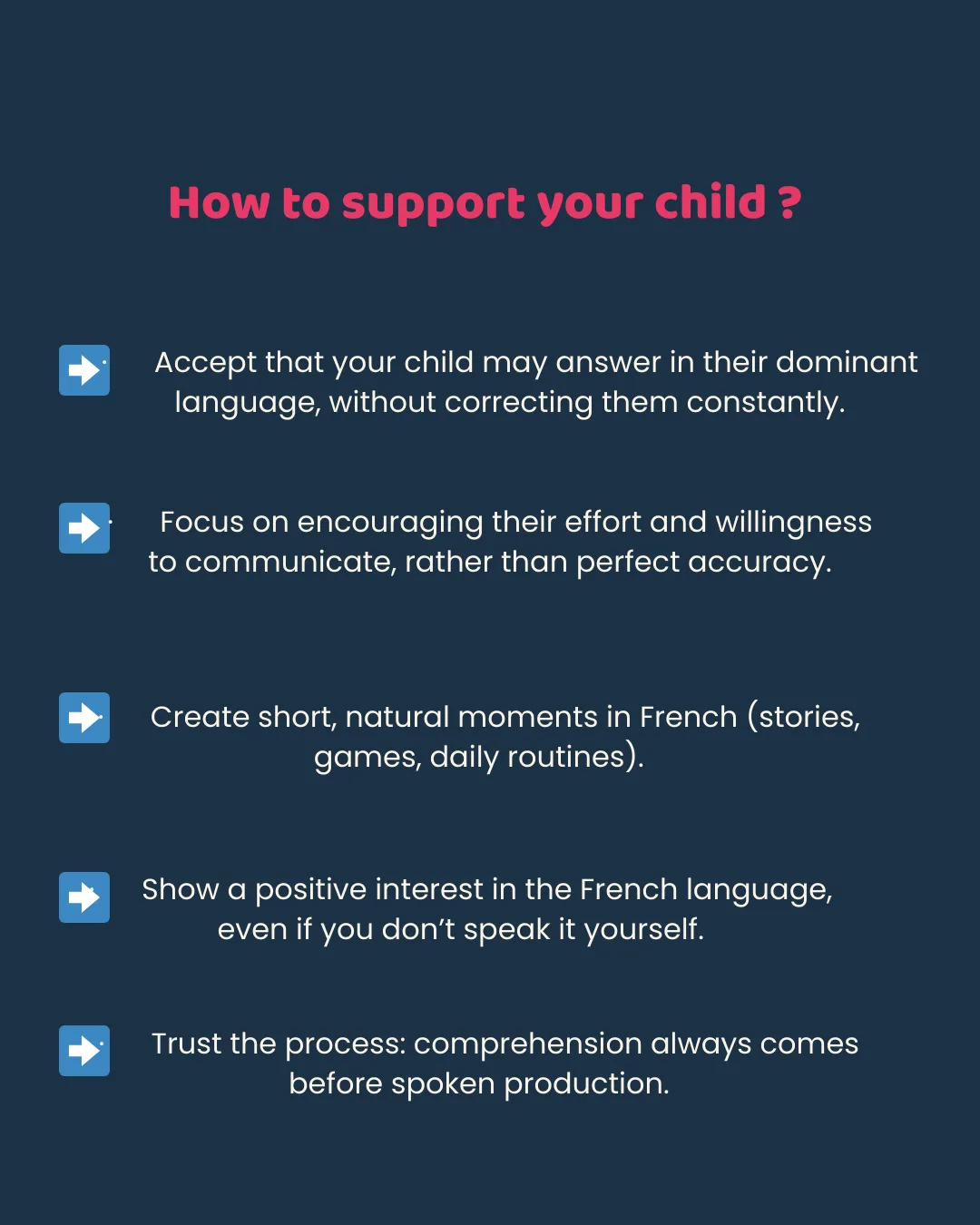
And yes, parents can help even if they don’t speak French themselves.
As a teacher specializing in supporting children, I assure you that every child can become multilingual. Just as you don’t become a swimming champion in a year, you don’t become multilingual in a few weeks.
Progress is seen over the long term. Your child is a champion in the making !
This helps a child to dare to speak French
A child is more likely to speak when:
- they do not feel pressure
- they feel emotionally safe
- they are encouraged, not corrected constantly
- they understand why they are learning French
- they are allowed to make mistakes
- they are allowed to use code-switching to communicate
Understanding the reason behind learning French gives meaning to the effort and motivation follows.
The importance of structured support
While time and patience are essential, a structured and supportive environment can make a real difference.
Children need:
👉 consistency
👉 reassurance
👉 a clear progression
👉 activities adapted to their level
👉 a rhythm that respects their individual pace
Rituals also make the child feel secure and help them gain confidence.
Supporting a child who understands French but does not speak it
This is exactly what I offer at The French Explorer School.
I provide children with:
🎯 a reassuring and caring learning environment
🎯 personalized progression
🎯 engaging, meaningful and fun activities
🎯 a rhythm adapted to each child
I also offer a free 30 minute trial class for your child.
If your child understands French but does not speak it yet, trust the process.
With time, the right environment and the right support, the words will come.
 English
  Spanish
  Chinese